


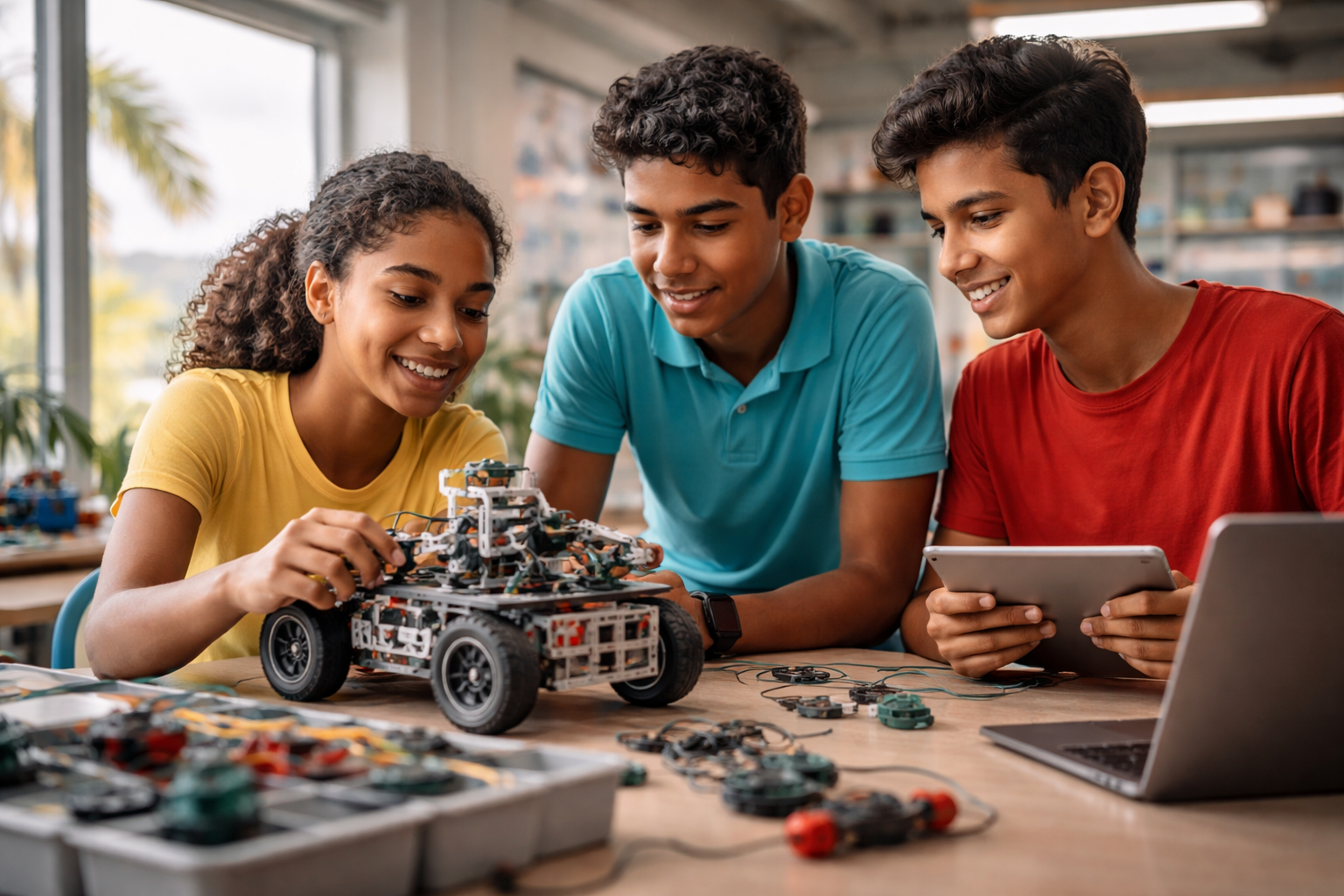
In recent years, robotics Mauritius has quietly evolved from a niche interest into a powerful tool for shaping the future of young people. While traditionally, education has focused heavily on academic performance and exam results, a shift is taking place—one that values problem-solving, creativity, and adaptability just as much as grades. Robotics and STEM (Science, Technology, Engineering, and Mathematics) are at the heart of this transformation, offering Mauritian youth not just skills, but confidence and direction.
STEM as Confidence-Building, Not Just Academics
For many students, school can feel like a system built around memorisation and testing. While foundational knowledge is important, it doesn’t always nurture confidence or independent thinking. This is where STEM education begins to change the narrative.
STEM Mauritius initiatives are increasingly showing that learning can be hands-on, engaging, and deeply personal. When a student builds something tangible—whether it’s a simple circuit or a functioning robot—they experience a sense of ownership over their learning. That moment of “I made this work” is powerful. It builds confidence in a way that textbooks alone cannot.
Students who may struggle in traditional classroom settings often thrive in STEM environments. They learn that failure is not something to fear but something to learn from. A robot that doesn’t move as expected becomes an opportunity to debug, rethink, and improve. Over time, this process develops resilience—one of the most valuable traits for the future.
What Robotics Teaches Beyond Coding
When people hear “robotics,” they often think of programming. While coding is certainly a part of it, robotics for students Mauritius goes far beyond writing lines of code.
Robotics is inherently interdisciplinary. It brings together engineering, design, logic, teamwork, and communication. Students must think critically about how different components interact. They learn how to break down complex problems into manageable steps—a skill that applies to nearly every aspect of life.
More importantly, robotics teaches collaboration. Rarely does a student build a robot entirely alone. They work in teams, each member contributing different strengths. One may focus on coding, another on mechanical design, and another on strategy. Through this, students learn how to communicate ideas, listen to others, and work towards a shared goal.
There’s also a creative dimension. Designing a robot requires imagination—how it moves, how it solves a problem, how it performs under constraints. In this way, robotics blends technical thinking with creativity, challenging the misconception that STEM is purely analytical.
How Global Exposure Changes Youth Ambition
One of the most transformative aspects of robotics Mauritius programmes is the exposure they provide. When students participate in competitions, workshops, or international collaborations, their perspective shifts dramatically.
A young person who once thought within the limits of their immediate environment suddenly begins to see global possibilities. They interact with peers from different countries, witness innovative ideas, and realise that their potential extends far beyond local boundaries.
This exposure does more than inspire—it raises ambition. Students start to envision careers in engineering, artificial intelligence, or technology entrepreneurship. They begin to understand the relevance of what they are learning and how it connects to real-world opportunities.
In a rapidly evolving global economy, this mindset is crucial. Mauritius, like many small island nations, must invest in human capital to remain competitive. Encouraging youth to think globally while acting locally is a key part of that strategy.
YUVA’s Approach to STEM Access and Opportunity
Access remains one of the biggest challenges in expanding STEM Mauritius initiatives. Not every student has the resources, mentorship, or exposure needed to explore robotics. This is where organisations like YUVA play a critical role.
YUVA’s approach is rooted in inclusivity. Rather than limiting STEM opportunities to a select group, they aim to bring robotics and technology education to underserved communities. Their programmes focus on making learning accessible, practical, and relevant.
Workshops are designed to be interactive and engaging, ensuring that students from all backgrounds can participate meaningfully. By removing barriers—whether financial, social, or geographical—YUVA helps level the playing field.
What stands out is their emphasis on long-term development. It’s not just about a single workshop or event; it’s about nurturing curiosity and building a pipeline of future innovators. Students are encouraged to continue learning, experimenting, and growing.
This approach recognises that talent exists everywhere—it simply needs the right environment to flourish.
How Parents and Sponsors Can Support
The growth of robotics for students Mauritius cannot happen in isolation. It requires a collective effort from parents, educators, businesses, and the wider community.
For parents, support begins with encouragement. Even if they are not familiar with robotics or STEM, showing interest in their child’s projects can make a significant difference. Providing time, space, and moral support allows children to explore without fear of failure.
Sponsors and corporate partners also have a vital role to play. Investing in STEM programmes is not just an act of corporate social responsibility—it is an investment in the future workforce. By funding equipment, workshops, and competitions, sponsors help create opportunities that might otherwise be out of reach for many students.
Schools can further strengthen this ecosystem by integrating STEM into their curricula and encouraging experiential learning. Partnerships between schools and organisations can amplify impact, ensuring that more students benefit from these initiatives.
Ultimately, supporting robotics Mauritius efforts is about recognising that education must evolve. The skills needed for the future—critical thinking, adaptability, collaboration—are best developed through experiences like robotics.
The Bigger Picture: Preparing Youth for an Uncertain Future
The world our youth are growing into is unpredictable. Technological advancements are reshaping industries at an unprecedented pace. Jobs that exist today may disappear tomorrow, while new ones emerge in fields we can barely imagine.
In this context, robotics and STEM are not just educational tools—they are preparation for life. They equip young people with the ability to learn, unlearn, and relearn. They foster curiosity, resilience, and a willingness to take on challenges.
Mauritius has an opportunity to position itself as a forward-thinking nation by investing in its youth. By expanding access to STEM and robotics, the country can cultivate a generation that is not only skilled but also innovative and adaptable.
Final Thoughts
The conversation around robotics Mauritius is not just about technology—it is about potential. It is about giving young people the tools to believe in themselves and to shape their own futures.
When a student builds their first robot, they are not just assembling parts; they are building confidence, curiosity, and capability. Multiply that experience across thousands of young people, and the impact becomes transformative.
Call to Action
Support the future of Mauritius by investing in its youth. Sponsor a student, fund a robotics programme, or partner with organisations working to expand STEM access. Small contributions today can create lasting change for tomorrow.

Leave a Comment