


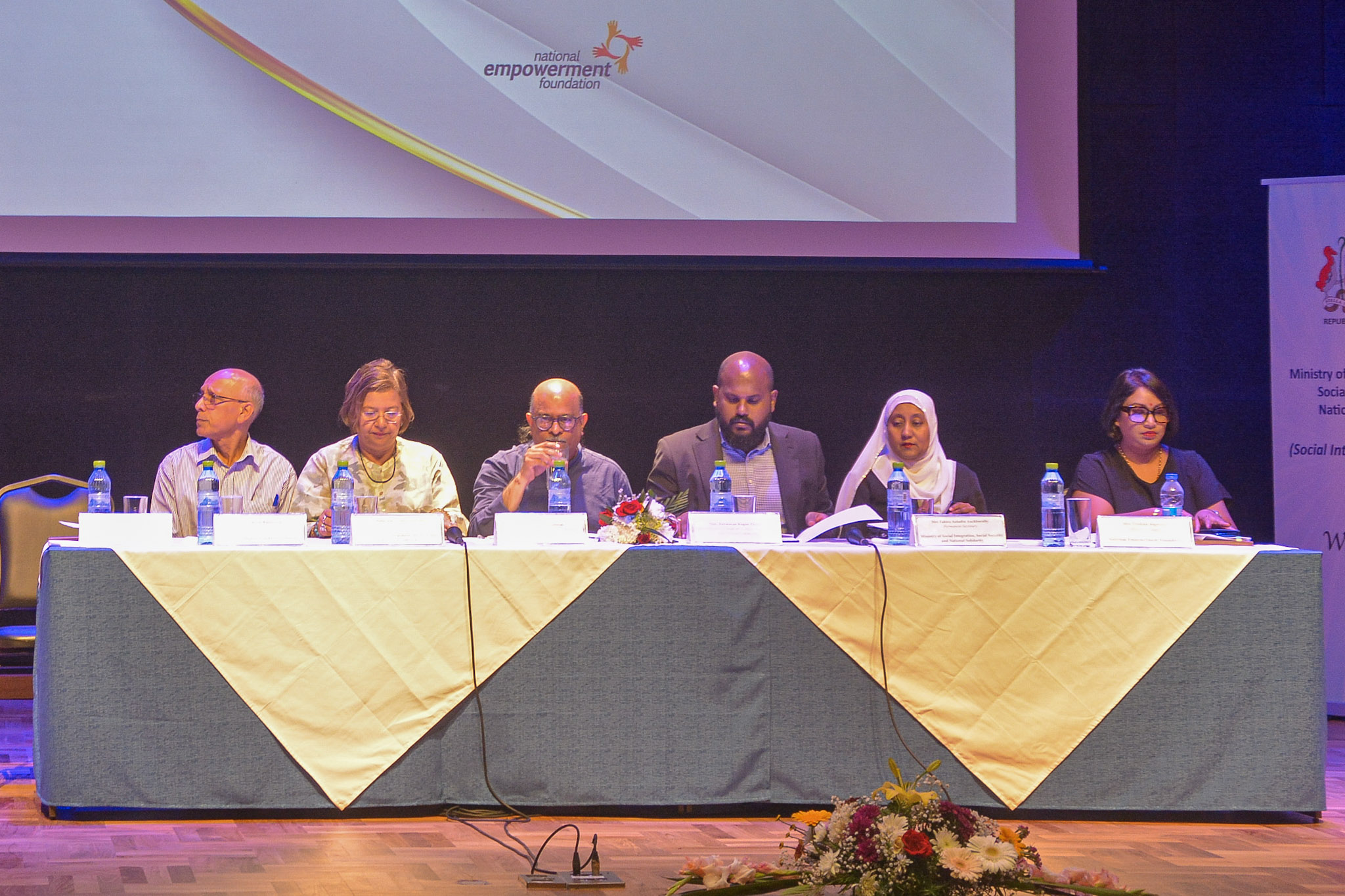
The auditorium of the Atal Bihari Vajpayee Institute of Public Service and Innovation in Côte d’Or was filled with purpose on Thursday, 16 October 2025, as policymakers, researchers, social workers, and community members gathered to observe the International Day for the Eradication of Poverty. The event, themed around understanding the multidimensional nature of poverty in Mauritius, was organised by the Ministry of Social Integration, Social Security and National Solidarity, in collaboration with the National Empowerment Foundation (NEF).
The symposium brought together a diverse range of speakers and participants to share insights, data, and lived experiences, aiming to promote a deeper understanding of what poverty truly means in the Mauritian context—and, crucially, how it can be effectively tackled.
Opening and Context
Following the National Anthem, the session began with a Welcome Address and an Introductory Note by Mr. Hootesh Ramburn, Chairman of the National Empowerment Foundation. His address highlighted the progress Mauritius has made in poverty alleviation, while also underlining the pressing need for updated data, new perspectives, and coordinated action.
This was followed by a Keynote Address by Honourable Ashok Kumar Subron, Minister of Social Integration, Social Security and National Solidarity, who provided an insightful overview of the government’s ongoing efforts to ensure that no Mauritian is left behind. He touched on themes of empowerment, resilience, and dignity—key principles guiding national policy.
The launch of the symposium was then marked by a projection of online testimonies from NEF beneficiaries, offering a human perspective on poverty that extended beyond statistics. These real-life stories set the tone for the day’s discussions: poverty is not only an economic issue, but a multidimensional challenge involving health, education, housing, employment, and human dignity.
Overview of Poverty in Mauritius
The first round of presentations focused on the current state of poverty in Mauritius. Presenters discussed the importance of robust data collection systems and poverty monitoring indicators to inform evidence-based policymaking. Representatives from the NEF emphasised the role of targeted social programmes in reducing inequalities and shared data highlighting trends across regions and vulnerable groups.
A key segment of this session was devoted to the Multidimensional Poverty Index (MPI), a comprehensive tool that examines poverty through several lenses—income, health, education, housing, and living standards. Rather than focusing solely on monetary measures, the MPI offers a more holistic picture of deprivation, allowing policymakers to design interventions that address multiple dimensions simultaneously.
The discussion also featured the Minister of Social Integration’s insights into the origins of International Day for the Eradication of Poverty and the ongoing challenges posed by uneven wealth distribution, indebtedness, and precarious employment in Mauritius. The Minister also stressed the need for psychological and social empowerment, particularly among women and single-parent households, to achieve sustainable poverty reduction.
The Role of Statistics Mauritius
The presentation by Statistics Mauritius provided an analytical perspective on the measurement and understanding of poverty trends. Using both the monetary and multidimensional approaches, their experts explored how the composition of poverty in Mauritius has evolved. They noted that while absolute poverty rates have declined, relative poverty and inequality remain areas of concern, especially among households affected by unemployment, rising living costs, and environmental vulnerabilities.
Their presentation highlighted how poverty is often compounded by overlapping issues such as violence, health crises, and climate change impacts. Addressing these interlinked challenges, they argued, requires integrated solutions that bring together data, social protection, and empowerment initiatives.
Testimonies and Lived Realities
Throughout the symposium, voices from NEF beneficiaries reminded attendees that poverty is not merely a statistic—it is a lived experience that affects dignity, opportunity, and wellbeing. One participant shared her experience of balancing multiple jobs to support her children, while another spoke about the challenges of finding secure employment despite technical qualifications.
Such testimonies reinforced the need to listen to the people most affected. As one participant aptly noted, “To understand poverty, you must go and talk with the poor—those who work hard, earn little, and still strive to live with dignity.”
These narratives served as a call for empathy-driven policymaking that not only provides financial support but also empowers individuals to reclaim agency over their lives.
Themes of Empowerment and Dignity
Discussions throughout the day centred around dignity, empowerment, and human rights as the cornerstones of social inclusion. Speakers from the Femmes Solidaires Foundation highlighted the need for psychological and financial stability for women, especially those heading households. Another presentation focused on hidden dimensions of poverty, such as malnutrition and mental health issues, often overlooked in traditional poverty assessments.
The symposium also addressed how racism and corruption can exacerbate poverty, restricting access to opportunities and deepening inequality. Calls were made for continued vigilance and institutional reforms to ensure that anti-poverty measures are fair, transparent, and inclusive.
Final Reflections and Closing Remarks
As the event drew to a close, Honourable Kuvalayan Kugan Parapen, Junior Minister of Social Integration, Social Security and National Solidarity, delivered a compelling speech addressing both relative and absolute poverty. He reminded the audience that eradicating poverty is not simply about increasing income—it is about transforming lives and ensuring equal access to education, healthcare, housing, and opportunity.
He encouraged continued collaboration among government agencies, NGOs, and local communities to foster sustainable, people-centred development. His message resonated deeply: the eradication of poverty begins with understanding, empathy, and collective action.
A National Commitment to Social Solidarity
The Symposium on Poverty 2025 served as a meaningful reminder that eradicating poverty requires both structural solutions and a human touch. Through data, dialogue, and shared experience, Mauritius continues to strengthen its national framework for social integration and empowerment.
The collaboration between the Ministry of Social Integration, Social Security and National Solidarity and the National Empowerment Foundation exemplifies how public institutions can create spaces for learning, empathy, and reform—building a more equitable and compassionate society for all.


Tereza Röslerová – Communications Officer

Leave a Comment